|
| |
Welcome to the 2nd ECA–ESMR Newsletter!
|
| |
We’re glad to have you back. This newsletter keeps our community up to date with ECA–ESMR news, upcoming events, EMC deadlines, and opportunities in muscle research, including open positions, fellowships, and grants.
|
| |
As always, we highlight a Spotlight Paper and feature Member Papers of the Month, where all submitted publications are shared with the community.
|
| |
If you’d like to promote your work or opportunities, feel free to get in touch.
|
| |
Happy reading!
|
| |
In this update...
|
| |
| • | Travel Fellowship: call & deadline
|
|
| • | Meet the Board Members series: Dr. Franziska Koser (ECA co-chair)
|
|
| • | Spotlight paper: Regeneration vs. resilience in aging muscle (Kang et al.)
|
|
| • | Member Paper of the Month
|
|
| • | Open positions in muscle research
|
|
| • | Did you know... the p-value was never meant to be a strict cutoff?
|
|
| • | Have FUN reading THIS paper: Banana physics
|
|
| |
~ 5 min read
|
| |
|
| |
Travel award 2026
|
| |
|
| |
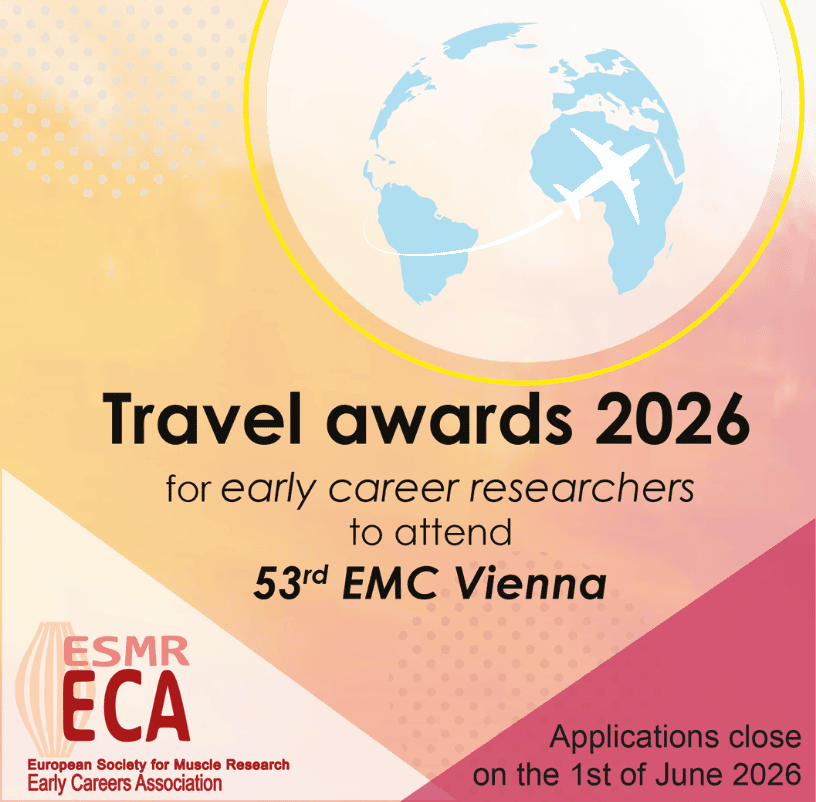
The EMC early careers research association is pleased to announce travel awards for early career researchers to attend the 53rd EMC in Vienna.
The purpose of the travel award is to support early career researchers (undergraduates, PhD students and researchers less than 10 years post PhD) with their travelling expenses (please note that applicants located in Austria cannot be considered for the EMC 2026 Travel awards).
To be eligible for the travel award, applicants must be members of the ESMR-ECA (please see the membership form at https://esmr.org/early-careers.html), their abstract for the EMC 2026 main conference must be accepted, and they must be present for the entire conference. Please note that travel awardees from the last two years (2024 and 2025) cannot be considered.
To apply, please complete the travel award application form at https://esmr.org/early-careers.html and email it to eca.esmr.info@gmail.com.
Applications close on the 1st of June, 2026.
Winners will be notified in mid/end June.
|
|
|
|
The EMC early careers research association is pleased to announce travel awards for early career researchers to attend the 53rd EMC in Vienna.
The purpose of the travel award is to support early career researchers (undergraduates, PhD students and researchers less than 10 years post PhD) with their travelling expenses (please note that applicants located in Austria cannot be considered for the EMC 2026 Travel awards).
To be eligible for the travel award, applicants must be members of the ESMR-ECA (please see the membership form at https://esmr.org/early-careers.html), their abstract for the EMC 2026 main conference must be accepted, and they must be present for the entire conference. Please note that travel awardees from the last two years (2024 and 2025) cannot be considered.
To apply, please complete the travel award application form at https://esmr.org/early-careers.html and email it to eca.esmr.info@gmail.com.
Applications close on the 1st of June, 2026.
Winners will be notified in mid/end June.
|
|
|
|
|
| |
Meet the board members
|
| |
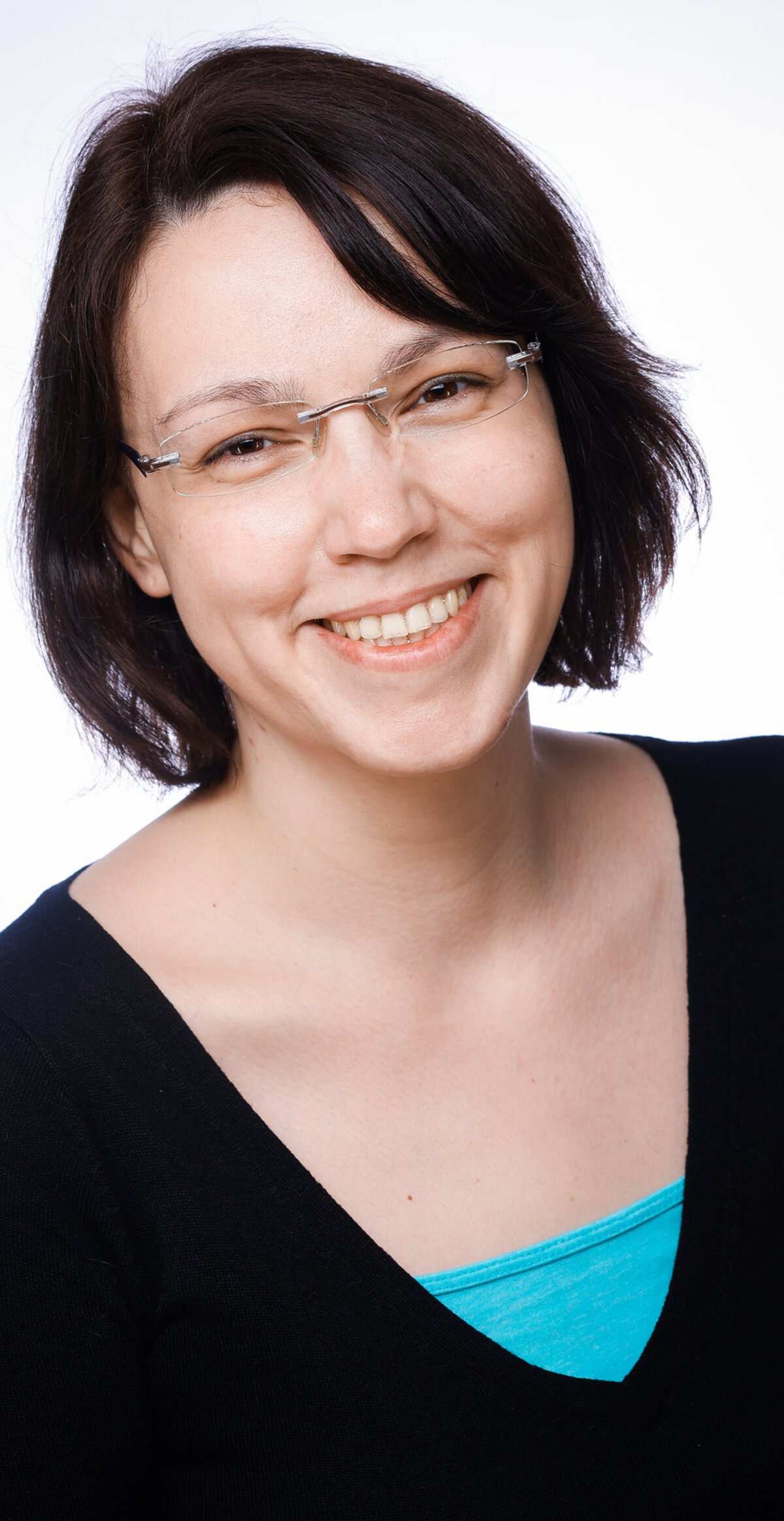
In our second Meet the Board Member feature, get to know Franziska, Co-Chair of the Early Career Association (ECA).
|
| |
| | Meet Franziska
| | | Based on her interest in cellular and molecular aspects of life, Franziska Koser studied biochemistry at the University of Halle-Wittenberg in Germany - 'so that she may perceive whatever holds. The world together in its inmost folds.' (Goethe, Faust I). She continued her studies in the field of cardiovascular research during her PhD at the University of Heidelberg and her postdoctoral research at the University of Münster in Germany. Currently, she is focusing her studies on heart failure with preserved ejection fraction – HFpEF, and the largest protein in the human body – titin.
Funfacts: In her previous life, she must have been a librarian – how else would you explain a living room filled with hundreds of books?
|
|
|
|
| | | Meet Franziska
| | | Based on her interest in cellular and molecular aspects of life, Franziska Koser studied biochemistry at the University of Halle-Wittenberg in Germany - 'so that she may perceive whatever holds. The world together in its inmost folds.' (Goethe, Faust I). She continued her studies in the field of cardiovascular research during her PhD at the University of Heidelberg and her postdoctoral research at the University of Münster in Germany. Currently, she is focusing her studies on heart failure with preserved ejection fraction – HFpEF, and the largest protein in the human body – titin.
Funfacts: In her previous life, she must have been a librarian – how else would you explain a living room filled with hundreds of books?
|
|
|
|
|
| |
|
| |
Spotlight paper
|
| |
|
| |
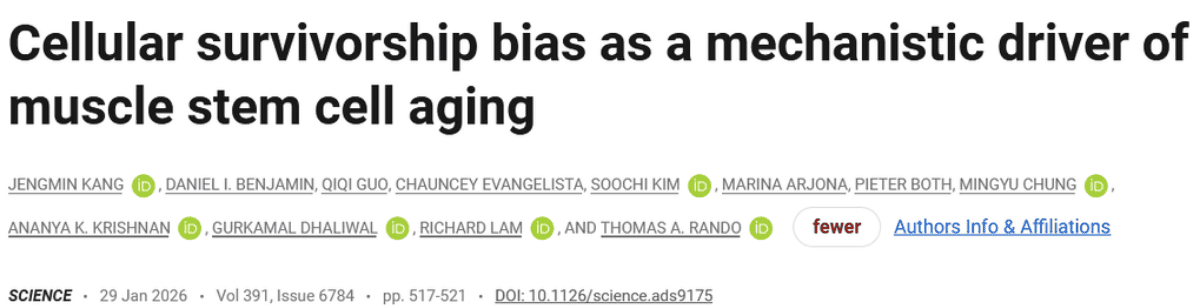
A recent study by Kang et al. shows that aging muscle stem cells may not simply lose function, but instead undergo a selection process that favors survival over regeneration. The tumor suppressor protein NDRG1 is upregulated in aged muscle stem cells, where it limits regenerative capacity while enhancing cellular resilience. Notably, reducing NDRG1 improves muscle regeneration, but at the cost of long-term cell survival, particularly after repeated injury. These findings suggest that age-related changes in muscle stem cells reflect a functional trade-off between regeneration and durability, rather than a straightforward decline in function.
|
| |
Read the full paper here
|
| |
Member Papers of the Month
|
| |
We congratulate our board member Kerstin Filippi on her recent publication in Nature Communications demonstrating that blockage of autophagy leads to severe skeletal muscle disruption in a mouse model of myofibrillar myopathy 6.
|
| |
Recently published?
Submit your work for consideration as our Spotlight Paper or to be featured in our Member Papers of the Month: esmr.eca.info@gmail.com
|
|
|
|
Recently published?
Submit your work for consideration as our Spotlight Paper or to be featured in our Member Papers of the Month: esmr.eca.info@gmail.com
|
|
|
|
|
| |
Open positions in muscle research
|
| |
| | | | | | | | | | | Research Technician - School of Sport, Exercise and Rehabilitation Sciences
|
| University of Birmingham, Birmingham UK
|
| | | | MSCA Postdoctoral Fellowships 2026
|
| European Commission / Marie Skłodowska-Curie Actions
|
| Host organisation of your choice
|
| | | Research professor in clinical motion analysis for childhood-onset neuromotor disability
|
| KU Leuven, Leuven, Belgium
|
| | | | Principal Scientist - Translational Muscle Biology
|
| | | | | Lymph vessel-on-a-chip: the role of muscle cell contractility for lymphedema
|
| KU Leuven, Leuven, Belgium
|
| | | | Professorship (open rank W1-Tenure-Track-W3, W2-Tenure-Track-W3 or W3) for Sports and Exercise Medicine
|
| Ruhr-Universität Bochum, Bochum, Germany
|
| | | | Open Rank-Tenure-Track Assistant/Associate or Full Professor in Exercise Science
|
| Syracuse University, Syracuse, NY, USA
|
| | | |
|
| |
|
| |
Did you know...
|
| |
...the famous p < 0.05 threshold wasn’t meant to be a strict rule?
|
| |
Ronald Fisher originally suggested it as a convenient guideline—yet it somehow became one of the most rigid “laws” in modern science.
|
| |
Read more about p-values and statistical significance in this Nature article: Scientists rise up against statistical significance
|
| |
|
| |
From Cartoons to the Lab: Banana Peel Physics
|
| |
Why are banana peels so slippery?
|
| |
An Ig Nobel Prize–winning study examined the frictional properties of banana peels and found that, when compressed, they release a gel-like substance that significantly reduces friction between surfaces. This creates an unexpectedly effective low-friction interface.
|
| |
Read the full paper here
|
| |
|
| |
|
| |
Follow us:
|
| |
|
| |
|
| |
|
| |
Thank you!
|
| |
|
| |
Don’t want to receive this newsletter? Unsubscribe by emailing:
|
| |
esmr.eca.info@gmail.com
|